Hello everyone, market enthusiasts and chart readers!
Today we dive into the heart of technical analysis to explore one of the most fascinating Japanese candlesticks, which at first glance might seem insignificant, but in reality tells us a lot about the market’s mood: the Spinning Top, or as we love to call it in Italian, the Trottola. Imagine a market that doesn’t quite know where to go, oscillating between buyers’ optimism and sellers’ pessimism, without either side managing to gain the upper hand. Well, this is the essence of the Spinning Top.
What is a Spinning Top (and why is it called that)?
The Spinning Top is a candle characterized by a very small real body and long shadows both above and below. The small body means that the opening and closing prices are very close to each other, indicating that, despite fluctuations during the session, the market ended almost exactly where it started. The long shadows, on the other hand, tell us that during that session prices tried to rise significantly (upper shadow) and fall significantly (lower shadow), but in both cases failed to maintain those extreme positions.
Think of a spinning top: it spins, it oscillates, it moves in every direction, but in the end it remains more or less stationary on its axis. Similarly, the price represented by the Spinning Top made large intraday movements, but did not take a clear direction. The color of the body (green/white for bullish or red/black for bearish) is almost irrelevant for this pattern, given its minimal size.
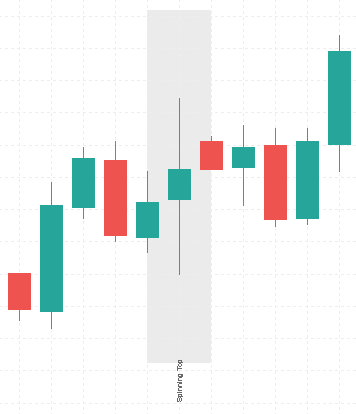 ◎ Struttura della Candela Spinning Top (Diagramma semplificato di una candela Spinning Top, evidenziando il corpo piccolo e le lunghe ombre superiori e inferiori.)
What Does the Spinning Top Tell Us? Indecision Reigns
The main message of a Spinning Top is indecision. It’s a signal that the market is in a state of precarious balance between the strength of buyers (bulls) and sellers (bears). Neither side has managed to conclusively dominate the other.
This state of balance can occur for several reasons:
- Trend exhaustion: After a long bullish or bearish movement, the market might “catch its breath,” and the Spinning Top would indicate that the strength of the previous trend is waning.
- Anticipation of news: The market might be awaiting important economic events, and participants prefer not to take decisive positions.
- Balance between supply and demand: Simply put, at that price level, supply and demand are equal.
It’s crucial to understand that the Spinning Top is not a strong reversal signal in itself, but rather a warning bell. It tells us: “Caution, things might change, or at least slow down.”
Context is King: Where Does Your Spinning Top Appear?
As with all candlestick patterns, the true power of the Spinning Top emerges only when analyzed in its context. A Spinning Top isolated on a chart can be just “noise”; a Spinning Top at a strategic point is gold.
- At the end of an uptrend: If you see a Spinning Top after a long and strong rally, it could indicate that buyers are losing momentum and sellers are starting to make their presence felt. This might precede a correction or a reversal.
- At the end of a downtrend: Conversely, after a prolonged descent, a Spinning Top could suggest that sellers are exhausted and buyers are finding the courage to enter, signaling a potential upward reversal.
- In a consolidation or sideways phase: Here, the Spinning Top is very common and reinforces the idea that the market has no clear direction, but is simply moving sideways awaiting a catalyst.
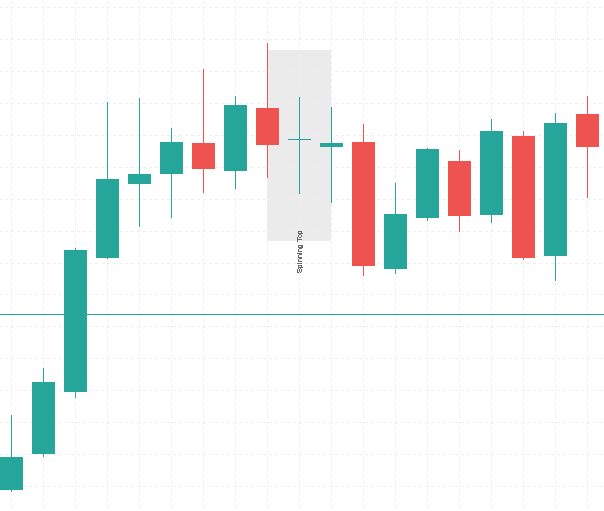 ◎ Spinning Top: Indecisione al Culmine di un Trend (Un grafico di prezzo che mostra una Spinning Top dopo un lungo movimento rialzista, seguita da un’inversione o consolidamento del prezzo.)
How to Use the Spinning Top in Your Trading
So, how can we use this “spinning top” to our advantage?
- Not a standalone entry signal: The Spinning Top is a warning signal, not a reason to open or close a position. It always requires confirmation.
- Look for confirmation: If it appears at the end of a trend, look for subsequent patterns that confirm the reversal (e.g., another reversal candle, a trendline breakout, increased volume).
- Key levels: A Spinning Top that forms at a significant support or resistance level is much more powerful than one that appears “in the middle of nowhere.” It means that buyers/sellers are fighting for that crucial level.
- Volume: Indecision accompanied by very low volume might simply indicate a temporary pause. Indecision with high volume could indicate a strong battle and a potential imminent turning point.
- Risk management: The Spinning Top can be an excellent time to review your positions. If you are in profit in a trend showing indecision, you might consider tightening your stop loss or taking partial profits.
Conclusion: A Signal to Think, Not to Act Impulsively
The Spinning Top, our little spinning top, is a powerful reminder that the market doesn’t always move in a clear and decisive direction. It’s a candle for reflection, inviting us to pause, observe, and await further developments before making important decisions.
Understanding the Spinning Top won’t give you an infallible trading signal, but it will make you a more aware chart reader, capable of grasping the nuances and underlying mood of the market. Remember: in trading, awareness and patience are often your best weapons. Keep studying, practicing, and connecting the dots!
Until the next deep dive!