Technical analysis is a language, and Japanese candlesticks are the words the market uses to tell us its story. Among the countless formations we can learn to read, the Morning Star is undoubtedly one of the most loved and respected by traders, a beacon of hope that appears after a dark night of decline. But what happens if this beacon lights up with an even more intense light? Enter the Morning Doji Star, a variant that not only confirms a bearish trend reversal but does so with such emphasis that it makes it a potentially more robust signal.
In this article, we will delve into the heart of the Morning Doji Star, exploring its composition, the psychology behind it, and why many consider it a stronger bullish signal than its more common counterpart.
What is the Morning Doji Star? The Three-Candle Signal
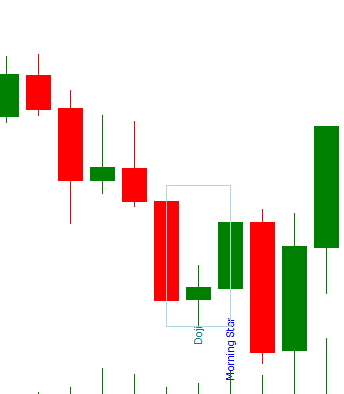
Imagine a battlefield. For days, bearish forces have dominated, pushing prices lower and lower. But then, something changes. The Morning Doji Star is a three-candlestick formation that tells us precisely this reversal of power:
The First Candlestick: The Reign of the Bears
- It is a long and bearish candlestick (red or black), which confirms the ongoing downtrend. It tells us that sellers are firmly in control and that pessimism is widespread.
The Second Candlestick: The Moment of Indecision – The Doji
- This is the heart of the formation, the turning point. It is a Doji, a candlestick characterized by an extremely small body (almost a line) and varying length shadows. This means that the opening and closing prices are almost identical. Ideally, this Doji should form with a bearish gap compared to the first candlestick, signaling that sellers tried to push even lower at the open, but without lasting success. The Doji indicates indecision, an almost equal struggle between buyers and sellers. Neither side manages to prevail.
The Third Candlestick: The Triumph of the Bulls
- It is a long and bullish candlestick (green or white), which opens with a bullish gap (ideally) relative to the Doji and closes deeply within the body of the first bearish candlestick, preferably above its midpoint. This candlestick is the definitive confirmation that buyers have taken control, sweeping away pessimism and demonstrating strong upward momentum.
 ◎ Struttura della Morning Doji Star (Illustration showing the three candlesticks: a long bearish one, a doji with a gap down, and a long bullish one that recovers ground.)
Why Does the Doji Make the Signal Stronger?
The fundamental difference between the “classic” Morning Star and the Morning Doji Star lies in the second candlestick. In the Morning Star, the second candlestick is simply a candlestick with a small body (whether bullish, bearish, or neutral), indicating a slowdown in the trend.
But a Doji is another story. The Doji is a symbol of extreme indecision, an almost perfect balance between supply and demand. After a long series of bearish candlesticks, the appearance of a Doji is like an “exclamation point” on the exhaustion of bearish strength.
- Think about this: If sellers have been so powerful as to drive prices down for days, their inability to push prices further after the Doji’s open (which ideally opens with a gap down) is a very strong signal. They tried to deliver the final blow, but encountered unexpected resistance. This stalemate is the first indication that their dominance is ending.
- When the third bullish candlestick then breaks onto the scene, the message is clear: buyers not only intervened but also reversed perception, transforming indecision into a wave of confidence. The energy accumulated during the Doji’s stalemate phase is released powerfully into the third candlestick.
The Psychology Behind the Signal
Let’s analyze the story the market tells us with this sequence:
- Widespread Pessimism (First Candlestick): Everyone is convinced that prices will continue to fall. Sellers dominate, and sentiment is negative.
- Doubt Arises (Doji): We reach a point where sellers can no longer significantly push prices down. Despite their persistence, buyers manage to hold the position, or even bring the closing price back near the opening price. The market pauses to reflect, like a boxer who, after delivering a series of blows, suddenly faces an opponent who won’t fall.
- The Turnaround (Third Candlestick): The Doji has created a power vacuum. Buyers, sensing the sellers’ weakness and the potential reversal of sentiment, enter strongly, pushing prices rapidly upward. The strong close of the third candlestick above the midpoint of the first bearish candlestick is proof that the tide has turned. Bears, caught by surprise, begin to close their short positions, further fueling the rally.
How to Use the Morning Doji Star in Your Trading
Like any candlestick pattern, the Morning Doji Star is not an infallible crystal ball, but a powerful tool if used correctly.
Context is King: This pattern has maximum validity when it appears after a clear and prolonged downtrend. If it appears during a consolidation phase or in an uptrend, its reversal significance is very limited.
Support Levels: The signal is even more powerful if the Doji (or the entire pattern) forms near a strong support level, such as a previous resistance area turned support, an important moving average, or a Fibonacci level.
Volume Confirmation: This is crucial!
- Volume should be high on the third bullish candlestick, indicating a strong influx of buyers.
- Ideally, the Doji’s volume might also be slightly higher than average, signaling the battle.
- A decrease in volume on the first bearish candlestick and an increase on the bullish body can strengthen the signal.
 ◎ Morning Doji Star con conferma del volume (Candlestick chart showing a Morning Doji Star forming after a downtrend, with a significant increase in volume on the third bullish candlestick.)
Entry Point: Traders usually consider a bullish entry after the close of the third candlestick. Some wait for a pullback (retracement) to the upper part of the pattern for a more conservative entry.
Stop Loss: Set the stop loss slightly below the low of the Doji or the low of the entire formation. This limit protects capital in case the signal turns out to be false.
Target Price: Use subsequent resistance levels as profit targets, or apply risk management tools like the risk/reward ratio (e.g., aiming for a gain at least double the potential loss).
Conclusion: A Strengthened Beacon of Hope
The Morning Doji Star is a bullish reversal formation that certainly deserves your attention. The presence of the Doji at its center not only signals critical indecision after a period of decline, but also amplifies its reversal message, making the subsequent bullish rebound even more convincing.
Always remember that no signal is infallible. Technical analysis is an art, not an exact science. Always combine the Morning Doji Star with other analysis tools (indicators, support/resistance levels, fundamental analysis, etc.) to increase the probability of success of your trades.
Now that you know this powerful signal, you are ready to spot the first rays of sun even after the market’s darkest nights!