Black (or Red) Marubozu: Unchallenged Bearish Pressure
Welcome to our blog, dear traders and market enthusiasts! Today we’re diving into one of the most direct and unequivocal signals the market can offer us through Japanese candlesticks: the Black (or Red) Marubozu. This pattern, with its exotic name and powerful meaning, is a true declaration of intent from sellers, a signal that leaves no room for doubt: bearish pressure has been total and unchallenged.
Imagine a football match where one team dominates the other from the first to the last minute, without allowing even a single shot on goal. Well, the Black Marubozu is exactly that in the world of trading: a day when the bears had absolute control, from open to close.
What is the Black (or Red) Marubozu?
The term “Marubozu” in Japanese means “shaved head” or “without obstacles.” When we talk about the Black Marubozu (or red, depending on the coloring you use for bearish candlesticks on your chart), we are referring to a candlestick with a distinctive and fundamental characteristic: the total absence of upper and lower shadows (or “wicks”).
This means that:
- Open Price = High Price: The candle opened at its highest point of the day.
- Close Price = Low Price: The candle closed at its lowest point of the day.
The body of the candle is therefore full and robust, a true “black rectangle” that shows no hesitation or recovery from buyers. There was no phase where prices rose above the open, nor did they recover above the closing low. It was a continuous and relentless decline.
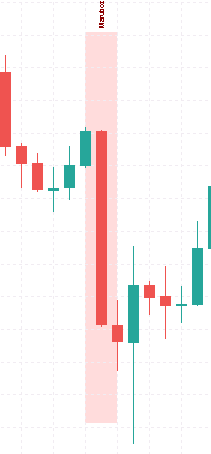 ◎ Structure of a Black (or Red) Marubozu Candlestick (Illustration of the Black Marubozu candle shape, showing a full body and absence of upper and lower shadows.)
The Meaning Behind the Absence of Shadows
The absence of shadows is what makes the Black Marubozu such a powerful pattern. It represents the absolute and unconditional dominance of sellers.
- No Hesitation: From the moment of opening, sellers took over and never let go. There was no significant attempt by buyers to push the price higher, not even for a moment.
- Maximum Bearish Pressure: The price moved steadily downwards throughout the entire trading session. This indicates strong selling pressure that prevailed over any buying interest.
- Extremely Bearish Sentiment: The Black Marubozu reflects a unanimous consensus that the price should fall. It’s as if the market said: “today we sell, and we sell hard!”
This candle is somewhat like a freight train that never decelerated and traveled the entire track downhill, without intermediate stops.
Interpretation and Implications for the Trader
When a Black Marubozu appears on your chart, it’s time to pay close attention. Depending on the context in which it appears, it can have several implications:
Confirmation of an Existing Bearish Trend: If the market is already in a downtrend, the appearance of a Black Marubozu strengthens conviction. It suggests that selling pressure is still very strong and that the trend is likely to continue vigorously. It’s a signal that sellers are in full control and there has been no sign of weakening in their momentum.
Reversal Signal after a Bullish Trend: Perhaps the most powerful interpretation. If a Black Marubozu appears at the end of a prolonged uptrend, it can be a strong reversal signal. It indicates that buyers, who had been dominating until then, completely lost control in a single day. It’s like a loud and clear alarm bell, indicating that market sentiment has drastically changed and a downward phase might be imminent.
Volume: The Silent Friend: Never forget to observe volume when a Black Marubozu appears. High volume accompanying the formation of this candle significantly amplifies its meaning. High volume confirms that a large number of market participants shared the same strong bearish sentiment, making the signal even more reliable.
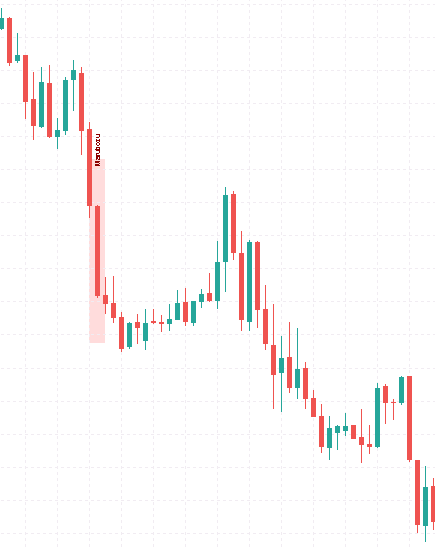 ◎ Black Marubozu: Continuation or Reversal Signal (Candlestick chart showing a Black Marubozu appearing in a market context, highlighting its impact on price.)
Practical Examples and Trading Strategies
How can we use the Black Marubozu in our trading strategy?
- Identification of Entry/Exit Points: If you are in a downtrend, a Black Marubozu can validate a short position or signal a good point to add another. If you are long in an uptrending market and see a Black Marubozu appear, it might be time to consider closing the position to protect profits or limit losses.
- Confirmation, Not Standalone Signal: Always remember that no candlestick pattern should be used in isolation. The Black Marubozu is a strong signal, but its reliability increases exponentially if confirmed by other technical indicators (such as moving averages, RSI, MACD), by support/resistance levels, or by other subsequent candlestick patterns.
- Risk Management: If you decide to trade based on a Black Marubozu, always define a clear stop loss. For example, if the Black Marubozu signals a reversal from an uptrend, a stop loss could be placed above the high of the previous candle or the absolute high of the just-ended uptrend.
Black Marubozu vs. Other Candlesticks
It is important to distinguish the Black Marubozu from other bearish candlesticks. Unlike, for example, a “Bearish Engulfing” or a “Dark Cloud Cover” which may have shadows or show phases of indecision, the Black Marubozu is pure bearish action. The absence of shadows is its signature and elevates its meaning to a higher level of determination and strength.
Conclusion
The Black (or Red) Marubozu is a candlestick pattern that every trader should know and respect. Its unequivocal shape, with its full body and absence of shadows, is a clear signal of unchallenged bearish pressure. Whether confirming an existing trend or announcing a potential reversal, the Black Marubozu tells us about a market where sellers have firmly taken the reins.
However, as with any technical analysis tool, the most effective interpretation comes from its application within the broader market context and in combination with other indicators. Keep studying, practicing, and integrating these valuable lessons into your trading arsenal!
Until the next analysis!