Hello everyone, market enthusiasts and those curious about the world of technical analysis! Today we’re delving into a candlestick pattern that, like a bolt from the blue, can signal a sudden and powerful reversal: the Bearish Downward Kick, or in English jargon, the Bearish Kicker.
Imagine being on a highway, traveling quickly in one direction, when suddenly, without any warning, the car sharply steers in the opposite direction. Well, the Bearish Kicker is a bit like that moment: a powerful signal indicating a sudden and often violent shift in market sentiment. Get ready to discover how to recognize it and, most importantly, what it means for your trading decisions!
What is the Bearish Kicker?
The Bearish Kicker is a two-candlestick pattern that forms on price charts and indicates a very strong, sudden selling pressure. It is one of the most powerful signals in candlestick analysis and is characterized by a fundamental element: a significant gap.
It’s not a simple reversal, but a true “kick” (hence the term “kicker”) that the market gives to the previous direction, decisively changing course.
The Anatomy of the Bearish Kicker: How to Recognize It
Recognizing a Bearish Kicker is relatively simple, but requires attention to precise details:
The First Candlestick (Bullish): This is a large bullish (usually green or white) candlestick, reflecting strong buying pressure and a consolidated bullish trend, or at least a strong positive momentum. This indicates that buyers are in control of the situation.
The Gap Down (Crucial!): This is the distinguishing element. The opening price of the second candlestick is significantly lower than the closing price of the first candlestick. This means that there was no trading between the close of the previous day and the open of the current day. It’s a real “leap into the void” downwards.
The Second Candlestick (Bearish): This candlestick is bearish (usually red or black) and of significant size, whose body develops entirely below the first candlestick, without overlapping it (apart from, possibly, the shadows). It opens with the gap and closes lower, indicating that sellers have taken control with overwhelming force.
In summary: You will see a bullish candlestick followed by a bearish candlestick that opens with a gap below the close of the previous candlestick and closes even lower. There is no overlap between the bodies of the two candlesticks.
 ◎ Anatomia del Bearish Kicker: Gap e Candele
(Illustration of a Bearish Kicker with a bullish candlestick followed by a bearish gap and a bearish candlestick with no overlap between bodies.)
◎ Anatomia del Bearish Kicker: Gap e Candele
(Illustration of a Bearish Kicker with a bullish candlestick followed by a bearish gap and a bearish candlestick with no overlap between bodies.)
The Psychological Meaning: A Violent Change of Guard
The meaning of the Bearish Kicker is profound and reflects a drastic change in market sentiment.
- First candlestick: Buyers are in command, optimism is high, the trend seems solid.
- The gap: Suddenly, something external to the market (unexpected negative news, downgrades, macroeconomic changes, or simply a collective “change of mind”) intervenes between yesterday’s close and today’s open. Traders, from one day to the next or from one session to the next, drastically re-evaluate their positions. No one is willing to buy at previous closing levels.
- Second candlestick: Sellers take over with such force that not only does the price open much lower, but it continues to fall, demonstrating strong bearish pressure. It’s a wave of panic or strong risk aversion.
This pattern indicates a sudden and aggressive takeover by the bears (sellers), who “kick” the bulls (buyers) out of the market.
Reversal or Continuation? A Signal of Extreme Weakness
The Bearish Kicker is primarily recognized as a strong bearish reversal signal, especially if it appears after a prolonged bullish trend. If you see it at the culmination of an ascent, consider that it might be a signal of an impending collapse or a significant correction.
However, it can also appear in an already consolidated bearish trend, acting as a continuation signal. In this case, it indicates an acceleration of the decline, as if the already falling market received an additional push downwards. It is not common as a continuation signal, but when it appears, it is an additional warning of strong weakness.
In both cases, its presence suggests that selling pressure has become dominant and sudden.
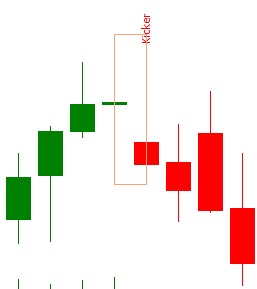 ◎ Bearish Kicker: Reversal Signal in Bullish Trend
(Chart showing a Bearish Kicker appearing at the end of a bullish trend, signaling a subsequent bearish reversal.)
◎ Bearish Kicker: Reversal Signal in Bullish Trend
(Chart showing a Bearish Kicker appearing at the end of a bullish trend, signaling a subsequent bearish reversal.)
How to Use the Bearish Kicker in Your Trading
Like any technical analysis signal, the Bearish Kicker should never be used alone. Here are some practical tips:
- Confirm with Volume: High trading volume on the second (bearish) candlestick and on the gap enormously strengthens the validity of the signal. Reduced volume, on the other hand, might indicate a trap or a less reliable signal.
- Trend Context: Evaluate the preceding trend. If it appears after a long bullish trend, it is a stronger reversal signal. If it appears during a bearish trend, it is a continuation.
- Support/Resistance Levels: The Kicker is even more powerful if it forms near a significant resistance level or an all-time high, where failure to break above that level triggers a chain reaction.
- Confirm with Other Indicators: Use other technical indicators (RSI, MACD, moving averages) to seek confirmations. For example, a bearish divergence on the RSI in conjunction with a Bearish Kicker would increase your confidence in the signal.
- Risk Management:
- Stop Loss: An intelligent stop loss placement would be just above the high of the first candlestick (or the second, if the latter has a higher upper shadow), to protect yourself in case the signal turns out to be false.
- Target Price: To define a take profit, you can look for subsequent support levels, use tools like Fibonacci retracements, or measure the potential volatility of the movement.
Conclusion
The Bearish Kicker is a powerful and fascinating pattern, a real “punch to the gut” for those expecting a bullish continuation. Its formation is a clear warning of sudden weakness and a possible change in market direction.
Always remember that no signal is infallible. Technical analysis is an art and a science that requires practice, patience, and the combination of multiple tools. Use the Kicker as an important arrow in your quiver, but always combine it with solid risk management and a broader contextual analysis.
Happy trading everyone!