Technical analysis is an art that combines chart study, market psychology, and a dash of intuition. Among its many facets, Japanese candlesticks are powerful tools that tell us stories about the behavior of buyers and sellers. Today we will discuss a pattern that, after a period of struggle, can ignite a beacon of hope: the Inverted Hammer.
Do you know that moment when, after a long decline, the price seems almost unwilling to rebound? Well, the Inverted Hammer is like a flag that, in that context, is planted to indicate a possible change of direction. But how do you recognize it, and more importantly, how do you interpret it? Let’s find out together!
What is the Inverted Hammer?
Imagine a candlestick with a small body (white or black, the color is less relevant than for the classic Hammer, though a white/green body can be slightly more bullish), a long upper shadow, and a very short or absent lower shadow. This is the visual description of the Inverted Hammer.
This configuration must appear after a significant downtrend. Its distinctive shape suggests that, even though sellers tried to push the price lower during the session, buyers (the “bulls”) managed to exert enough pressure to bring the price back near the opening or even the highest closing of the day. It’s as if the bulls had “tested” the strength of the bears, demonstrating a surprising ability to react.
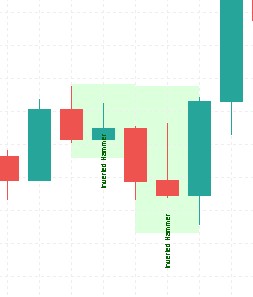 ◎ Caratteristiche dell'Inverted Hammer (Martello Inverso) (An illustration showing a candlestick with a small real body at the bottom, a long upper shadow, and an almost non-existent lower shadow.)
The Psychology Behind the Signal
The most fascinating aspect of candlesticks is the psychology they reveal. In the case of the Inverted Hammer, the message is clear: sellers are losing ground.
Think of the market as a battle. During a downtrend, sellers (the “bears”) dominate, pushing prices lower and lower. But when an Inverted Hammer appears, it’s as if buyers (the “bulls”) have attempted a significant incursion, pushing the price to rise considerably from its open, even if it then retreated back near the initial levels. The fact that the bulls managed to push so high, even temporarily, after a long period of decline, is a sign that selling pressure might have exhausted or, at least, weakened.
It’s an indication that the bearish momentum that has dominated the market so far may have reached its peak. The bulls, who were previously sidelined, are starting to flex their muscles, ready to reverse the trend.
The Inverted Hammer as a Buy Signal
If the Inverted Hammer appears after a downtrend, it can be interpreted as a potential bullish reversal signal. It’s a warning that the market might be ready for a rebound or a complete trend reversal.
Caution: “potential” is the keyword! No single candle can guarantee a reversal. The Inverted Hammer is a clue, not a verdict. For this reason, it is crucial to seek confirmation.
Confirmation is Key!
Never venture into a trade based solely on a single candle. For the Inverted Hammer, confirmation is vital and should come from the subsequent candle:
- Bullish Confirmation Candle: The candle following the Inverted Hammer should be a bullish (green or white) candle that closes above the Inverted Hammer’s real body, and ideally above its upper shadow. This indicates that buyers have taken control and are indeed pushing prices higher.
- Volume: An increase in volume during the formation of the Inverted Hammer and/or the confirmation candle further strengthens the signal. High volume means that many market participants are acting, confirming the reversal sentiment.
- Market Context: The Inverted Hammer is more significant if it forms near important support levels, relevant moving averages, or corresponds to an oversold condition according to indicators like the RSI.
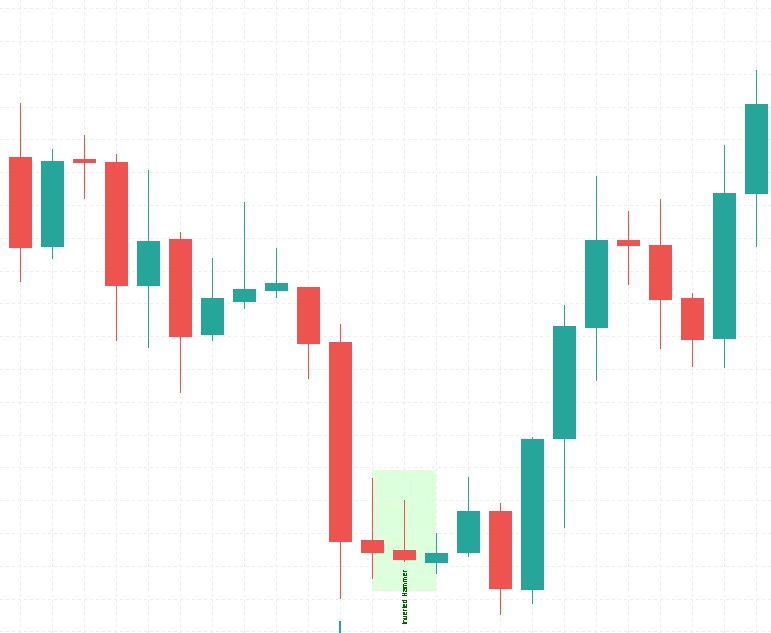 ◎ Esempio Grafico: Inverted Hammer seguito da conferma rialzista (A candlestick chart showing a downtrend, followed by an Inverted Hammer candle, and then a strong bullish candle confirming the trend reversal. The volume below the chart shows an increase coinciding with the signal.)
How to Use It in Trading
Once you have identified an Inverted Hammer and received confirmation, here’s how you might consider acting:
- Entry Point: Entry could be considered after the close of the confirmation candle, or at the open of the candle following the confirmation, once the price surpasses the high of the Inverted Hammer or the confirmation candle itself.
- Stop Loss: To manage risk, place your stop loss below the low of the Inverted Hammer. If the price falls below that level, the signal is likely invalidated, and the bearish trend could resume.
- Profit Target: Potential profit targets can be identified using previous resistance levels, moving averages, or Fibonacci retracements.
Limitations and False Signals
Like any technical analysis tool, the Inverted Hammer is not infallible:
- Can Appear Without Reversing: Sometimes, an Inverted Hammer can appear in the middle of a downtrend, and the price continues to fall. This is why confirmation is crucial.
- Requires Context: Its effectiveness increases exponentially when combined with other technical analysis tools (indicators, trend lines, support/resistance levels). Never isolate a signal.
- Size Matters: A very long upper shadow relative to the small body is more significant than a slightly longer shadow.
Conclusion: Hope, but with Caution
The Inverted Hammer is undoubtedly one of the most interesting and often profitable candlestick patterns for traders looking for reversal signals after a downtrend. It is a candle that tells a story of a potential power shift between bears and bulls.
Always remember that trading is a matter of probabilities, not certainties. The Inverted Hammer is a “hope for a bullish reversal on the horizon,” not a guarantee of an inversion. Use it as a valuable clue, but always in combination with broader analysis and solid risk management. The key is vigilance, patience, and, above all, confirmation. Happy trading!